Sysquake for LaTeX
Sysquake for LaTeX is a LaTeX package based on Sysquake. LaTeX is the de facto standard for high-quality scientific publications, from internal memos to articles and books. One of the most cumbersome and least automatized tasks is the inclusion of figures. Typically, it involves at least two separate applications, and manual adjustments to obtain the desired size and text font. Sysquake for LaTeX provides an elegant solution: keeping unchanged the habits of the LaTeX author, it makes the power of Sysquake available directly from a few simple LaTeX commands.
Designed by a LaTeX user for LaTeX users, Sysquake for LaTeX is really a huge leap forward. In addition to scientific documents written once by their author, Sysquake for LaTeX can be an invaluable help in the automatic creation of reports in a wide range of areas: surveillance of infrastructures, buildings or factories, laboratories, finance, etc.
Operating
Sysquake for LaTeX is made of two parts: the LaTeX package itself, a .sty file (source code) which defines new commands; and a separate compiled program which interprets Sysquake code fragments and produces LaTeX output and EPS files. For the author, Sysquake for LaTeX is used like any other LaTeX package: typesetting is performed as usual, and Sysquake results are inserted seamlessly in the DVI or PDF output file.
Sysquake for LaTeX runs with any LaTeX distribution with the shell escape extension (\write18), such as TeXLive and MiKTeX. Should shell escape be missing, the Sysquake for LaTeX interpreter could be run in a separate typesetting phase.
In order to permit typesetting even in the absence of a working Sysquake for LaTeX interpreter, typically on unsupported platforms, a simple option disables the execution of Sysquake code fragments, but still includes text and graphical results if they exist. This makes sharing, publication and archiving safe.
Example
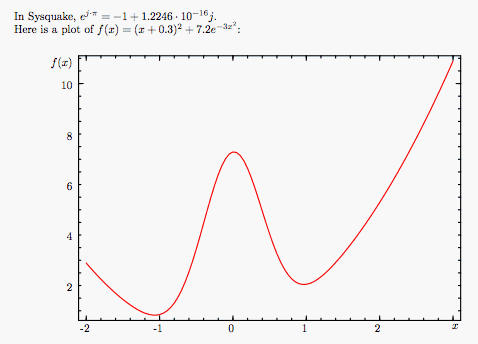
The small example below gives you an idea of how to use Sysquake for LaTeX. Command sqexpr and environment sysquake are defined in package sysquake.
\documentclass{report}
\usepackage[latexingraphics]{sysquake}
\usepackage{graphicx}
\usepackage{epstopdf}
\begin{document}

In Sysquake, $e^{j \cdot \pi} = \sqexpr{exp(1j * pi)}$.

Here is a plot of $f(x) = (x+0.3)^2 + 7.2 e^{-3x^2}$:

\begin{sysquake}(400,300)
a = 7.2;
fplot(@(x) (x+0.3)^2+a*exp(-3*x^2), [-2,3], 'r');
label '$x$' '$f(x)$';
\end{sysquake}

\end{document}
The result produced by pdflatex is shown below (you can also get the PDF file itself).
For a more detailed overview, you can read the tutorial of the User Manual.
Documentation
You can read Sysquake for LaTeX documentation online.
License
Sysquake for LaTeX may be used freely.
The full license is provided in the User Manual. To summarize, Sysquake for LaTeX is a free download and may be redistributed as a whole.
Availability
Sysquake for LaTeX is available now as a free download.